When charge carriers in one circuit cannot connect to another circuit, the two circuits are galvanically isolated because no conductive connection exists. This is effected by transformers, optocouplers, or capacitors. If electrical power or signals are to be exchanged in this configuration, this must take place via magnetic fields, infrared radiation, or a charge transfer mechanism.
A classic example of a galvanic isolation is the mains transformer connected to the public power grid.
The fluid handled is very rarely a pure liquid (see also Gas separation). Both solid and gaseous substances are usually present in the fluid (see Two-phase flow). Gases can be present in a liquid in dissolved and undissolved form. In the dissolved form, the gas molecules are distributed throughout the liquid and attached to the liquid molecules as a result of physical forces; undissolved gas is present in a liquid in the form of bubbles.
In most cases, the amount of a particular type of dissolved gas cannot exceed the specific limit defined by the properties and condition of the liquid (excluding unstable supersaturated conditions), however, there is practically no upper limit to the amount of undissolved gas a liquid may contain. This is largely dependent on the nature of the fluid's motion. If the fluid is at rest, degassing usually commences rapidly (e. g. the bubbles rise to the surface of the liquid), and the dissolved gas content approaches its maximum value. A measuring device invented by van Sylke is used to determine the gas content in a liquid. It separates the dissolved gas under vacuum and measures its volume.
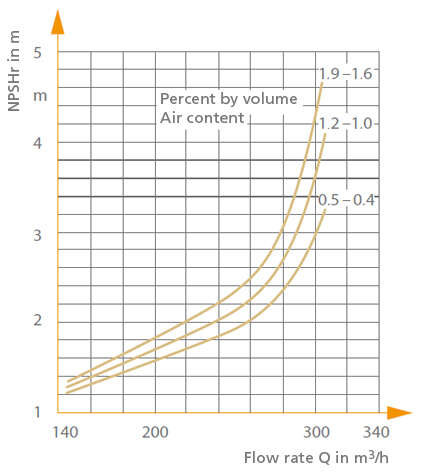
Dissolved gases in fluids have an effect on the suction characteristics of centrifugal pumps in so far as a high gas content results in an increase in the required NPSH and thus leads to earlier instances of cavitation.
See Fig. 1 Gas content of fluid handled
Fig. 1 Gas content of fluid handled: Influence of dissolved air on suction characteristics of a radial centrifugal pump n = 1450 rpm, Qopt = 210 m³/h, Impeller diameter D = 404 mm
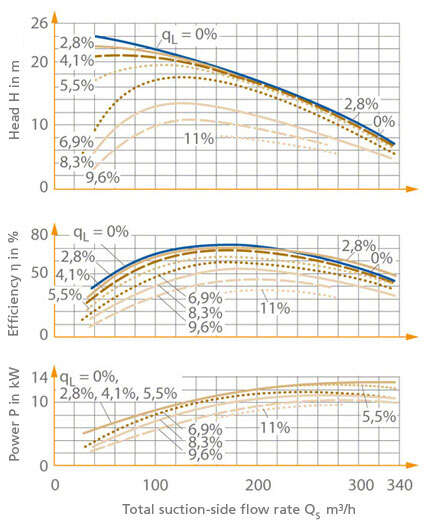
Undissolved gas in bubble form influences the overall operating behaviour, and the extent to which gas can be entrained varies widely and continuously according to the design, size and mode of operation of the pump concerned. Fig. 2 Gas content in the fluid handled illustrates the changes in the characteristic curve H(Q), η(Q) of a non-clogging impeller pump (impeller) as a function of the percentage of air entrained.
Fig. 2 Gas content of fluid handled: Influence of undissolved air on the operating behaviour of a non-clogging impeller pump handling prefiltered waste water (open three-vane impeller, D = 250 mm, n = 1450 rpm) qL = Air volume/mixture volume (suction nozzle) in %, QS = Suction-side volume flow rate in m³/h
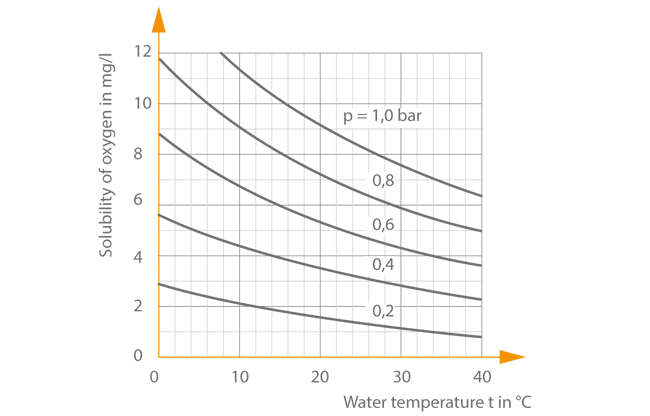
Gas separation describes the process of gas separating from the fluid handled due to changes in pressure. The solubility of air in water depends on the water's temperature and pressure (see Gas content of fluid handled). As solubility decreases in line with decreasing pressure and increasing temperature, air comes out of solution in the pumps' suction lines or in siphoning lines (see siphoning lines (see Formation of air pockets). See Fig. 1 Gas separation
Fig. 1 Gas separation: Solubility of oxygen in water as a function of water pressure and water temperature
The gases which have come out of solution accumulate at the apex of the line and have to be removed to prevent separation of the water column.
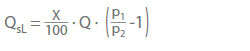
Relative to the suction conditions, the average volume (QSL) removed per hour in the case of suction lines is:
X Volume percent of air dissolved in water at the absolute pressure of 1 bar Q Flow rate of pump or in siphoning line in m3/h p1 Absolute water pressure in bar at the beginning of the evacuation process. p2 Absolute water pressure in bar at the end of the evacuation process (for pumps operating on suction lift, the absolute suction pressure at flow rate (Q) should be entered in the equation)
The following applies to siphoning lines: See Fig. 1 Siphoning line
e Height difference of both water levels in m
es Height difference between apex and inlet side water level in m v Flow velocity in m/s Σζ Sum of resistance coefficients (see Pressure loss) pb Atmospheric pressure in bar
If the apex lies close to the collecting tank, the following equation applies:
The volume of gas which comes out of solution is removed by an automatic evacuation system (see Venting). Gassy liquids such as waste water and sewage also liberate gas in the low pressure zones of the impeller which impairs the pumping performance.
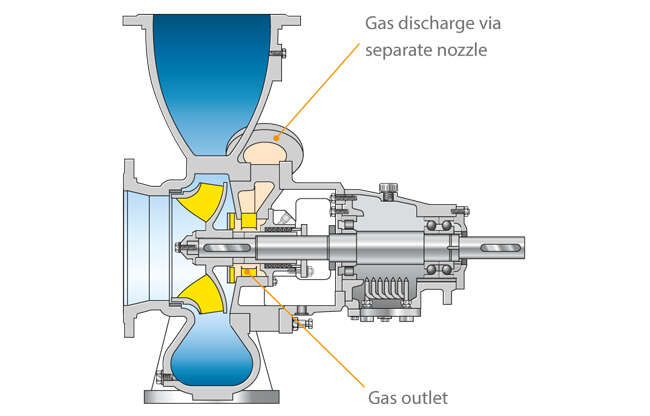
Applications in the food, paper and pulp industries require gas to be pumped alongside the fluid handled. A pump should therefore be designed in such a way that gas separation and fluid transport can take place simultaneously. See Fig. 2 Gas separation
Fig. 2 Gas separation: Volute casing pump in back pull-out design with gas outlets and separate nozzle for gas discharge
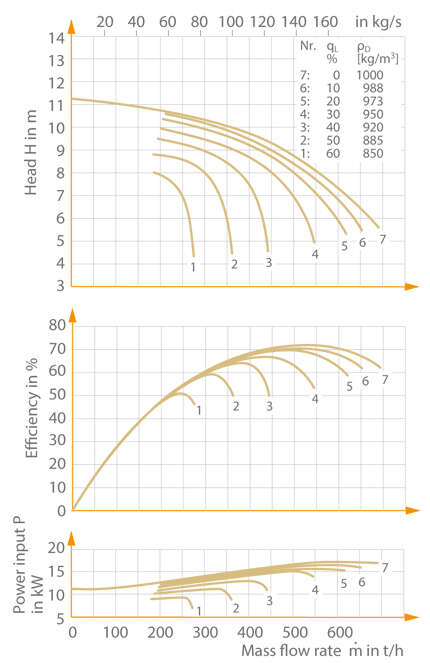
The pump is provided with a device which separates the gas collected at the impeller inlet and presses it to the impeller outlet. From there it is discharged via a separate pipe. This device enables the efficient pumping of fluids with a gas content of up to 60 %. See Fig. 3 Gas separation
Fig. 3 Gas separation: Characteristic curves of a volute casing pump (Fig. 2 Gas separation) with closed diagonal impeller (D = 315 mm, n = 875 rpm) depending on the gas content qL (gas volume in the fluid handled in %)
Gaskets are sealing elements, used where the parts to be sealed are in contact with each other and do not perform a relative movement (static).
They are mostly employed in apparatus engineering and piping construction. Effective static sealing requires relatively high forces to be applied to the axially sealing gasket.
Gear drives are ideal for achieving an optimal type of pump (in terms of design effort and operating data) where higher power is involved. In this context, the rotational speed of the pump must be selected independently of the rotational speed of the drive.
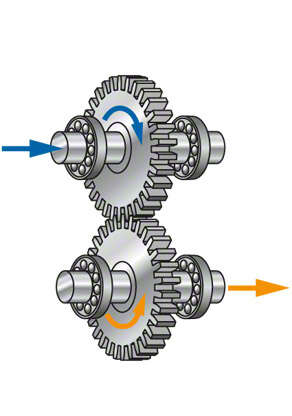
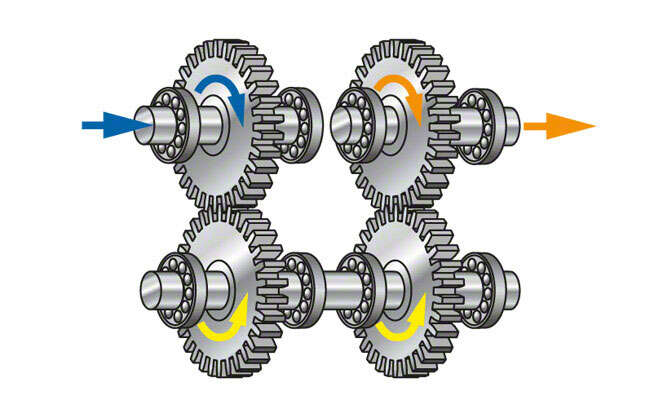
Depending on the transmission ratio required, either a single-stage or multi-stage type of gear unit can be used. See Figs. 1 and 2 Gear drive
Fig. 1 Gear drive: Single-stage gear drive, direction of rotation is reversed
Fig. 2 Gear drive: Two-stage gear drive, direction of rotation remains the same
If the pump's impellers (or the individual impeller) are attached directly to the gear drive output shaft, the latter and the driven machine form a compact set as with the close-coupled pump and geared pump.
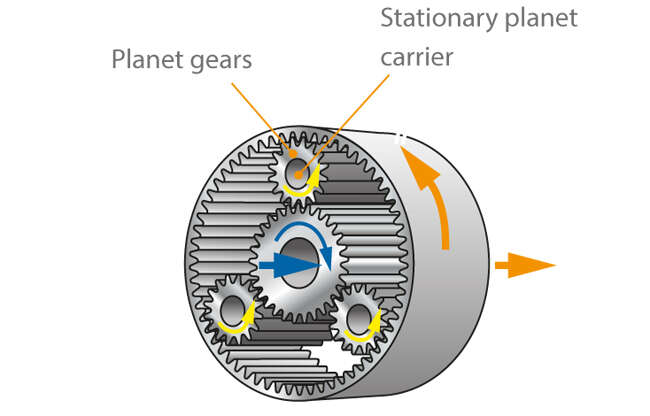
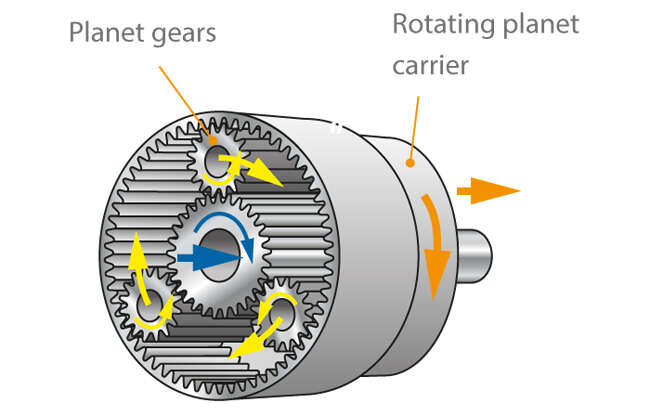
If high transmission ratios are required with the driven and the drive machines in a line, it is advisable to use planetary gear units, see Fig. 3 Gear drive, and star gears, see Fig. 4 Gear drive, because the rotationally symmetrical casing geometry is ideal for turbomachinery as well as electric motors. The same applies to similarly high gear reduction ratios as with pumps for use in low-lift pumping stations.
Fig. 3 Gear drive: Planetary gear unit with stationary planet carrier, direction of rotation is reversed; transmission ratio i = 2 to 11 with three planet carriers
Fig. 4 Gear drive: Planetary gear unit with rotating planet carrier (star gears), direction of rotation remains the same; transmission ratio i = 3 to 12 with three planet carriers
In the case of high gear circumferential speeds, a high degree of production accuracy is required from the perspective of noise emissions (see noise in pumps and systems).
A gear pump is a rotating positive displacement pump, whose meshing teeth of the two gear wheels simultaneously serve as displacement bodies and separating elements. This self-priming pump generates high static pressures, e.g. in lubricating oil systems.
A gear unit includes moving connections with revolving parts for transmitting or converting rotary motion (e.g. gear drive, hydraulic torque converter).
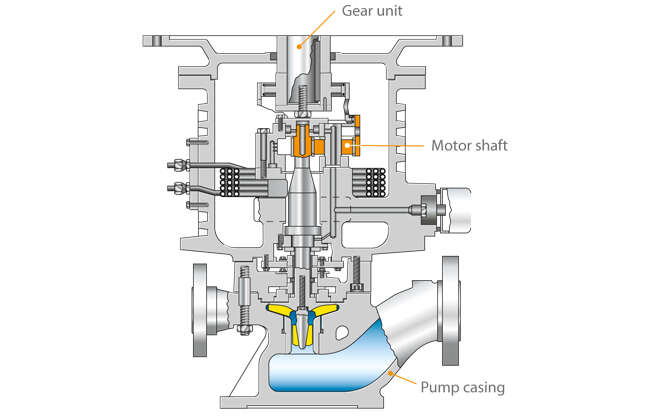
Geared pumps are centrifugal pumps with a gear drive fitted between the pump shaft and the drive. A special variant is the high-pressure gear pump, a high-speed pump which is used to generate large heads(opens in a new tab) (up to 1000 m) at small flow ratesand high efficiencies. If used with a normal 2 or 4 pole electric motor a transmission gear is required to achieve a rotational speed of approximately 15,000 rpm, which is unusually high for a centrifugal pump. Such pumps comprise of a pump casing (in-line version), an openimpeller with radial vanes and inducer, two mechanical seals for sealing off the fluid handled and the gear oil, and a radial and axial bearing supporting the sun gear (central gear) of the transmission gear (power split transmission) arranged above.
The motor is firmly flanged to the gear housing and fitted with a coupling, at its shaft end. The coupling meshes with the annulus, which drives the planet gears of the gear drive Decisive factors for the wear resistance of gears are the manufacturing quality, the lubrication of bearings and gear wheels, and the correct lubricant maintenance for cooling and cleaning purposes. See Fig.1 Geared pump
The single-stage back-pull out design, enables the complete rotating assembly to be pulled out towards the top and minimises any downtimes required for assembly work.
The in-line design (see In-line pump) only requires a minimum foundation size and allows for straightforward installation. Gentle speed changes can be achieved by selecting sufficiently small gear steps from the modular system. Each casing design is usually assigned a variety of impeller diameters and a corresponding diffuser design.
Thanks to the variation options by changing the input speed, transmission ratio, inducer, diffuser size, impeller size and trimmed impeller diameter any requiredoperating point in the characteristic curves selection chart depending on the suction-side inlet conditions can be attained economically for a high-pressure geared pump.
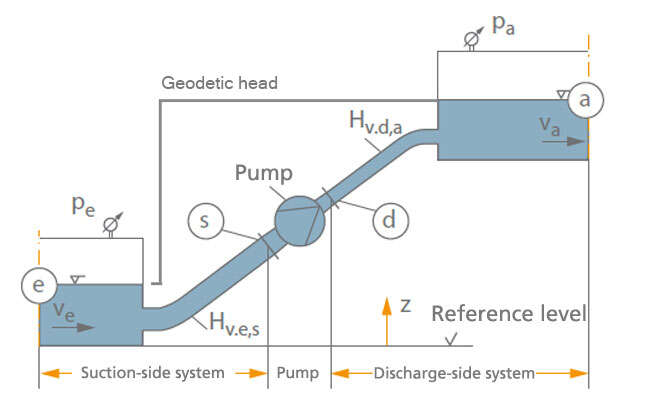
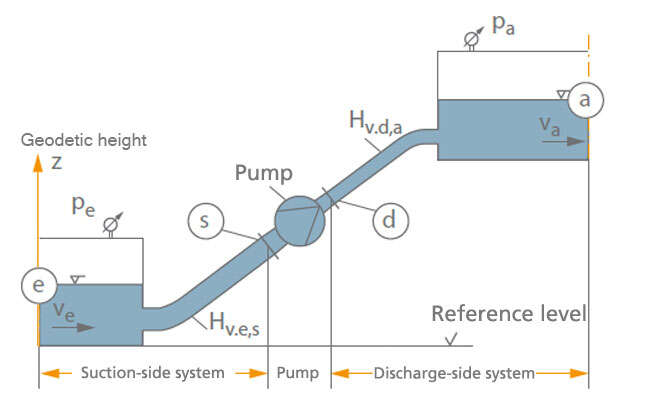
The geodetic height refers to the elevation (z) of a chosen point of a centrifugal pump or pump system with regard to a specified datum level. See Fig. 1 Geodetic height and Fig. 1 NPSH
Fig. 1 Geodetic height: Illustration of the magnitudes relating to the system head Hsys
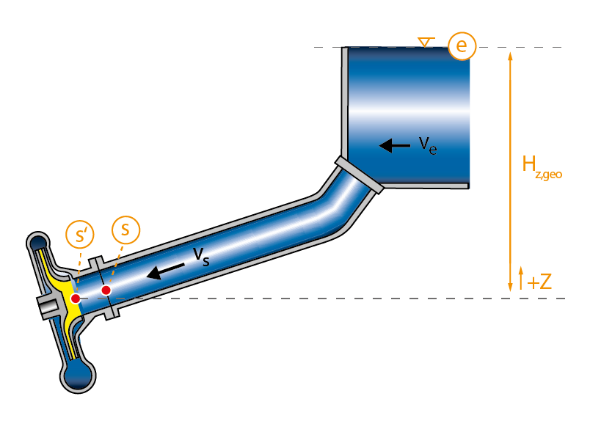
The geodetic positive suction head (Hz.geo) is the difference between the liquid level in the inlet tank and the impeller's centreline. If the geodetic positive suction head chosen is sufficient, it will reduce the risk of cavitation. See Fig. 1 Geodetic positive suction head
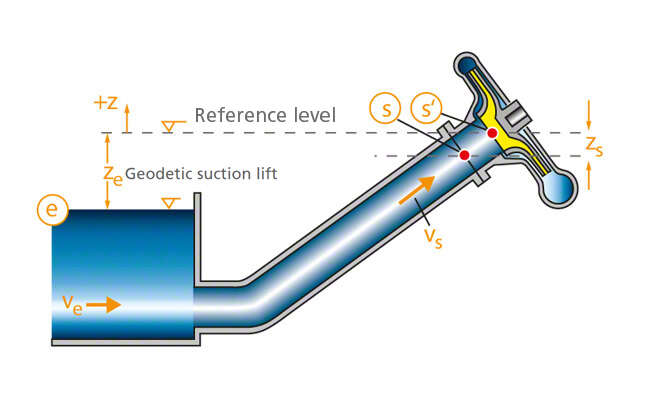
The geodetic suction lift (Hs.geo) is the difference between the suction-side liquid level and the impeller's centreline. Depending on the atmospheric pressure, water temperature and the location's altitude (measured in metres from the sea level), the theoretical maximum geodetic suction lift under ideal conditions is 10.33 m. Especially in the case of centrifugal pumps, however, cavitationwill occur earlier at a suction lift of approx. 8 m due to both friction in the suction line and vapour formation. See Fig.1 Geodetic suction lift
The German Equipment and Product Safety Act [Geräte- und Produktsicherheitsgesetz] regulates how products are placed on the market and exhibited within the context of an independent commercial undertaking.
The gland packing is a contact-type sealing element. Compared with other types of shaft seals, they are adjustable and suitable for use with pressures and circumferential speeds higher than those radial shaft seal rings are used for (see also Shaft seal).
In the context of acceptance testing of a centrifugal pump a guarantee is provided to warrant compliance with contractually agreed physical values and technical properties of the pump (also see Warranty tolerance).
The acceptance test codes of DIN EN ISO 9906 and the Hydraulic Institute (HI) use the term "guarantee" in the technical sense. The contractually agreed values are the basis for verification within the scope of the acceptance test. The values and properties to be guaranteed are selected to match the design and intended use of the centrifugal pump.
In order to fulfil the guarantee, the pump characteristics guaranteed in the purchase contract must in the acceptance test lie within the tolerance ranges of the measuring results as specified in DIN EN ISO 9906 or by HI.
Any detailed test to verify guaranteed data causes costs which should always be in economically reasonable proportion to the pump purchase price. Any rights and obligations that might result from non-compliance with agreed values are not the subject of the codes.